
What Is OWASP Top 10? Explained Briefly (Complete Beginner’s Guide 2026)
Sunday, August 2, 2026
Introduction
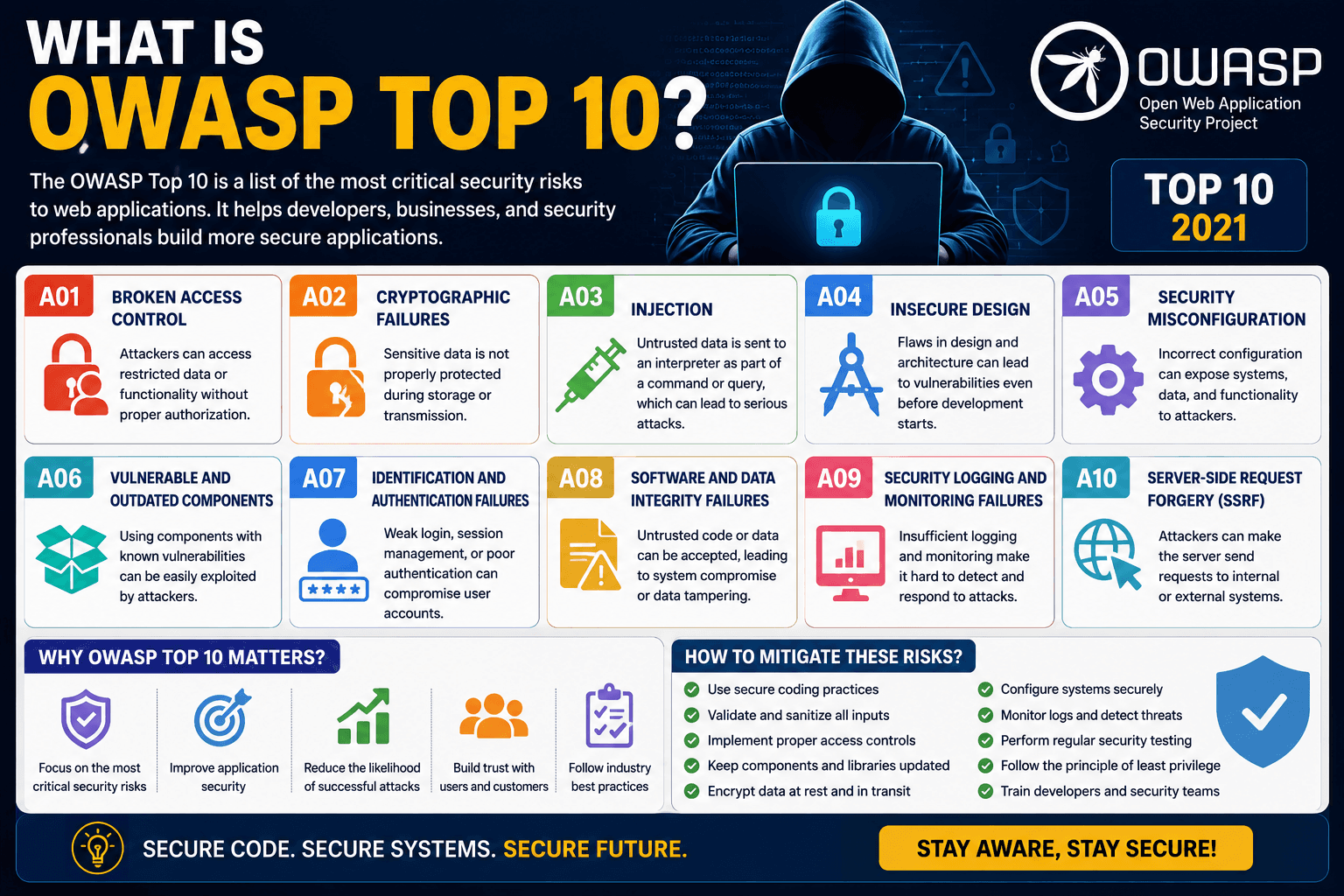
As cyberattacks continue to grow in sophistication, securing web applications has become one of the biggest priorities for businesses and developers. Every day, hackers exploit weaknesses in websites and web applications to steal sensitive information, damage systems, or gain unauthorized access. To help developers understand and prevent these common vulnerabilities, the Open Worldwide Application Security Project (OWASP) publishes the OWASP Top 10, a globally recognized list of the most critical web application security risks.
Whether you’re a beginner, web developer, ethical hacker, cybersecurity student, QA engineer, or software tester, understanding the OWASP Top 10 is essential. These vulnerabilities are frequently tested during penetration testing, bug bounty programs, security audits, and software development.
In this guide, we’ll explain what the OWASP Top 10 is, why it’s important, briefly discuss each of the ten vulnerabilities, and share best practices to secure your applications.
What Is OWASP?
OWASP (Open Worldwide Application Security Project) is a non-profit organization dedicated to improving software security. It provides free resources, tools, documentation, projects, and guidelines to help developers build secure applications.
Some of OWASP’s most popular resources include:
OWASP Top 10
OWASP Web Security Testing Guide (WSTG)
OWASP Cheat Sheet Series
OWASP Juice Shop
OWASP Dependency-Check
OWASP ZAP (Zed Attack Proxy)
These resources are widely used by developers, ethical hackers, and security professionals worldwide.
What Is the OWASP Top 10?
The OWASP Top 10 is a regularly updated awareness document that identifies the ten most critical security risks affecting web applications.
Rather than covering every possible vulnerability, it highlights the most common and impactful categories based on real-world security data. Organizations use the list to improve secure coding practices, prioritize security testing, and reduce application risk.
Why Is the OWASP Top 10 Important?
Learning the OWASP Top 10 helps organizations and developers:
Build secure web applications
Reduce security vulnerabilities
Protect customer data
Prevent financial losses
Improve secure coding practices
Meet compliance requirements
Strengthen customer trust
Reduce the likelihood of cyberattacks
For cybersecurity professionals, it’s also a foundational topic in interviews and certifications.
OWASP Top 10 Explained Briefly
A01: Broken Access Control
Broken Access Control occurs when users can perform actions or access resources they should not be allowed to.
Example
A normal user changes a URL to access another customer’s account or administrative dashboard.
Prevention
Implement proper authorization checks.
Use role-based access control (RBAC).
Deny access by default.
Validate permissions on the server side.
A02: Cryptographic Failures
This vulnerability involves weak encryption or improper protection of sensitive data such as passwords, payment information, or personal records.
Example
A website stores passwords in plain text or uses outdated encryption algorithms.
Prevention
Use strong encryption standards.
Always use HTTPS/TLS.
Hash passwords with modern algorithms.
Encrypt sensitive information at rest and in transit.
A03: Injection
Injection attacks happen when untrusted input is interpreted as commands or queries by a backend system.
Example
SQL Injection allows attackers to manipulate database queries and retrieve or modify data.
Prevention
Use parameterized queries.
Validate user input.
Sanitize inputs.
Avoid dynamic query construction.
A04: Insecure Design
Even well-coded software can be insecure if the application’s architecture or business logic lacks proper security considerations.
Example
Building a password reset feature without rate limiting or identity verification.
Prevention
Follow secure design principles.
Perform threat modeling.
Conduct security reviews during design.
Apply the principle of least privilege.
A05: Security Misconfiguration
Improper system configuration can expose applications to unnecessary risks.
Example
Leaving default passwords enabled or exposing debug pages in production.
Prevention
Disable unused services.
Remove default accounts.
Keep configurations secure.
Regularly audit server settings.
A06: Vulnerable and Outdated Components
Using software libraries, frameworks, or plugins with known security flaws increases risk.
Example
An application runs an outdated framework with publicly known vulnerabilities.
Prevention
Keep dependencies updated.
Remove unused libraries.
Monitor security advisories.
Perform regular vulnerability scans.
A07: Identification and Authentication Failures
Weak authentication mechanisms can allow attackers to compromise user accounts.
Example
Allowing unlimited login attempts without account lockout or multi-factor authentication.
Prevention
Enforce strong passwords.
Enable multi-factor authentication (MFA).
Protect sessions securely.
Implement rate limiting.
A08: Software and Data Integrity Failures
Applications may trust code or data from unverified sources, creating opportunities for compromise.
Example
Installing packages from an untrusted repository without verifying their integrity.
Prevention
Verify software signatures.
Secure CI/CD pipelines.
Validate updates.
Use trusted repositories.
A09: Security Logging and Monitoring Failures
Without proper logging and monitoring, organizations may not detect or investigate attacks promptly.
Example
A successful attack occurs, but there are no logs available to determine what happened.
Prevention
Enable centralized logging.
Monitor security events.
Set up alerts for suspicious activity.
Review logs regularly.
A10: Server-Side Request Forgery (SSRF)
SSRF occurs when an attacker tricks a server into making requests to unintended internal or external resources.
Example
An image upload feature fetches a URL supplied by the user, allowing access to internal systems.
Prevention
Validate and restrict URLs.
Use allowlists where appropriate.
Isolate internal services.
Disable unnecessary outbound requests.
Best Practices to Prevent OWASP Top 10 Risks
To strengthen application security:
Follow secure coding standards.
Validate and sanitize all user inputs.
Use HTTPS across the application.
Implement strong authentication and authorization.
Keep frameworks and libraries updated.
Conduct regular penetration testing.
Perform code reviews.
Monitor application logs continuously.
Use automated security scanning tools.
Train developers on secure development practices.
Who Should Learn the OWASP Top 10?
The OWASP Top 10 is valuable for:
Web Developers
Software Engineers
Ethical Hackers
Penetration Testers
Bug Bounty Hunters
Cybersecurity Analysts
QA Engineers
DevSecOps Engineers
Students pursuing cybersecurity
Security Consultants
Understanding these vulnerabilities helps professionals build and assess more secure applications.
Career Benefits of Learning the OWASP Top 10
Knowledge of the OWASP Top 10 can improve your prospects for roles such as:
Cybersecurity Analyst
Penetration Tester
Ethical Hacker
Application Security Engineer
DevSecOps Engineer
Security Consultant
SOC Analyst
Vulnerability Assessment Engineer
Bug Bounty Researcher
It is also beneficial when preparing for certifications like CEH, OSCP, Security+, and other application security-focused credentials.
Frequently Asked Questions (FAQs)
Is the OWASP Top 10 only for ethical hackers?
No. It is designed for developers, testers, architects, security professionals, and anyone involved in building or maintaining web applications.
Is the OWASP Top 10 free?
Yes. OWASP publishes the Top 10 and many other security resources free of charge.
How often is the OWASP Top 10 updated?
The list is updated periodically to reflect changes in the web application security landscape, based on industry data and expert input.
Is the OWASP Top 10 enough to secure an application?
No. It is an awareness document that covers the most critical categories of web application risks. Comprehensive security also requires secure architecture, coding standards, testing, monitoring, and ongoing maintenance.
Why should developers learn the OWASP Top 10?
It helps developers recognize common vulnerabilities early, write more secure code, reduce security defects, and improve the overall resilience of applications.
Conclusion
The OWASP Top 10 is one of the most important resources for anyone involved in web application development or cybersecurity. By understanding these ten major vulnerability categories—from Broken Access Control and Injection to Security Misconfiguration and SSRF—you can identify common risks and apply effective security controls throughout the software development lifecycle.
Whether you’re a beginner learning cybersecurity, a developer writing secure applications, or an ethical hacker performing security assessments, mastering the OWASP Top 10 is a valuable step toward building safer, more resilient web applications in 2026 and beyond.