
What Is Performance Marketing and How Does It Work? ( In hindi )
Sunday, February 1, 2026
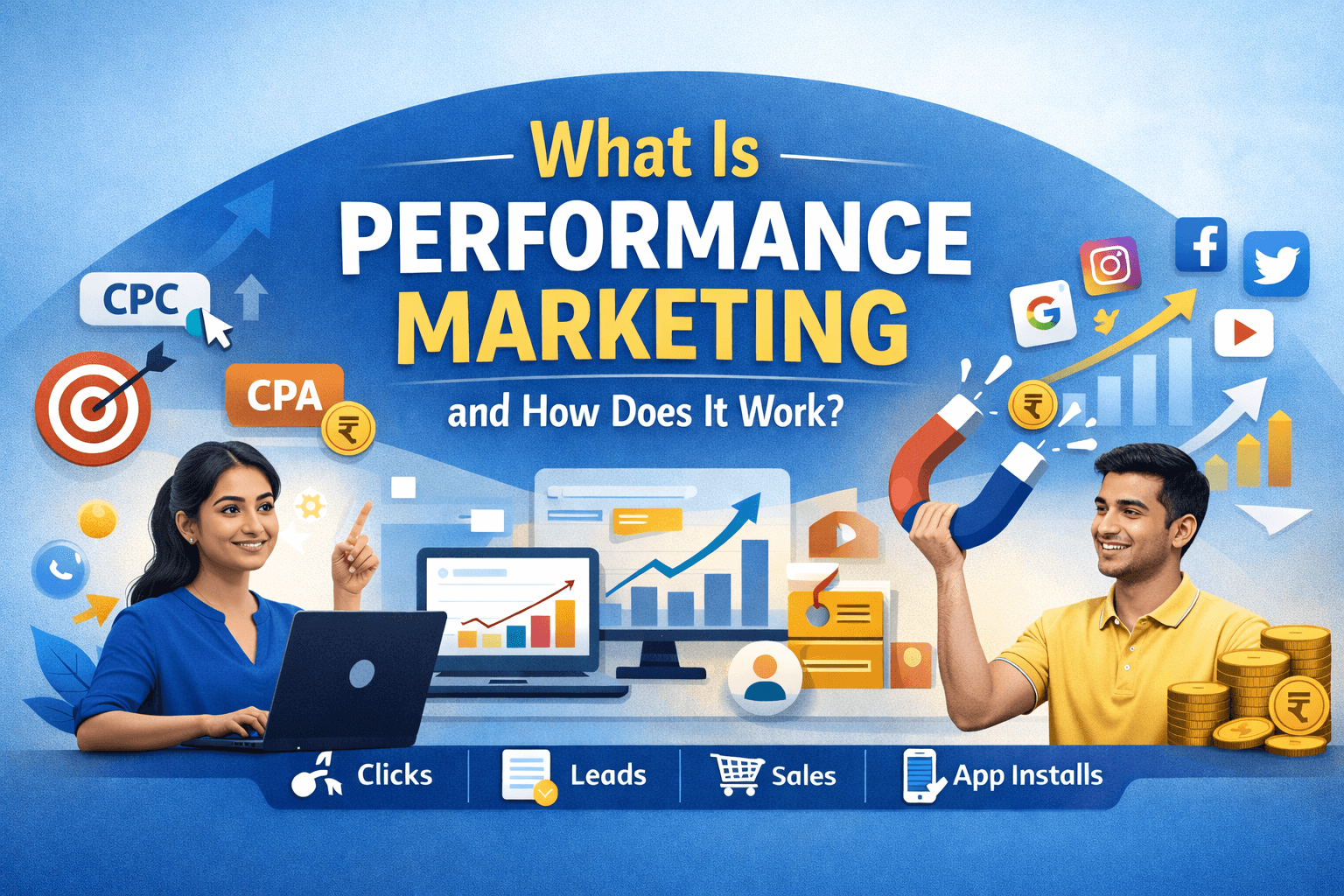
Performance marketing is a results-driven digital marketing strategy where businesses pay only when a specific action happens. That action could be a click, lead, sale, app install, or sign-up. Unlike traditional advertising, you don’t pay just to show your ad—you pay only when it actually performs.
In simple terms, performance marketing means paying for outcomes, not assumptions. This is why it has become one of the most popular marketing models for startups, online businesses, and large brands alike.
Understanding Performance Marketing in Simple Words
Earlier, companies spent money on TV ads, newspapers, hoardings, or radio without knowing how many people actually took action. The focus was mostly on visibility, not results.
Performance marketing changed this completely.
With performance marketing:
Every campaign has a clear goal
Every action is tracked
Every rupee spent can be measured
If an ad doesn’t work, you stop it.
If an ad performs well, you scale it.
This makes performance marketing transparent, flexible, and cost-effective.
What Actions Are Measured in Performance Marketing?
Performance marketing campaigns are built around specific, trackable actions such as:
Clicks (CPC – Cost Per Click)
Leads (CPL – Cost Per Lead)
Sales or conversions (CPA – Cost Per Acquisition)
App installs
Email sign-ups or subscriptions
Before running any campaign, marketers decide which action matters most for the business.
How Does Performance Marketing Work?
Performance marketing follows a clear and practical process.
1. Define the Goal
First, the business decides what result it wants.
For example:
Increase product sales
Generate leads
Drive traffic to a website
Get more app downloads
A clear goal helps measure success accurately.
2. Choose the Right Advertising Platform
Ads are run on platforms where the target audience is active, such as:
Google Ads
Facebook and Instagram Ads
YouTube Ads
Affiliate networks
Native advertising platforms
Each platform offers different formats and targeting options.
3. Target the Right Audience
One of the biggest strengths of performance marketing is precise targeting.
You can target users based on:
Location
Age and gender
Interests
Search intent
Online behavior
This ensures ads reach people who are most likely to convert.
4. Track and Measure Results
Tracking tools like:
Google Analytics
Conversion tracking
Facebook Pixel
help monitor:
Clicks
Conversions
Cost per result
Return on investment (ROI)
This data shows exactly what is working and what is not.
5. Optimize for Better Performance
Based on performance data, marketers:
Pause poor-performing ads
Improve ad creatives
Optimize landing pages
Increase budget on winning campaigns
This ongoing optimization is the core of performance marketing success.
Main Channels of Performance Marketing
1. Search Engine Marketing (SEM)
This includes paid ads on search engines like Google.
When users search for a keyword related to your product or service, your ad appears. You pay only when someone clicks the ad.
This works best for high-intent users.
2. Social Media Advertising
Platforms like Facebook, Instagram, LinkedIn, and Twitter allow advertisers to run highly targeted ads using images, videos, and carousels.
Social ads are great for:
Brand awareness
Lead generation
Retargeting previous visitors
3. Affiliate Marketing
Affiliate marketing is a classic example of performance marketing.
Affiliates promote a product, and they earn a commission only when they generate a sale or lead. This model is low risk and scalable for businesses.
4. Native Advertising
Native ads blend naturally with website content and feel less intrusive.
Because they match the look and feel of the platform, they often get higher engagement and better conversion rates.
5. Performance-Based Influencer Marketing
Some brands work with influencers on a performance basis, paying them per sale or lead instead of a fixed fee.
This ensures brands pay only for real results.
Benefits of Performance Marketing
Measurable Results
Every action can be tracked in real time, making it easy to measure success.
Cost Control
Budgets are spent only on campaigns that deliver results.
Higher ROI
Money is invested in ads that actually convert.
Real-Time Optimization
Campaigns can be adjusted instantly based on performance data.
Full Transparency
Advertisers know exactly where their money is going.
Performance Marketing vs Digital Marketing
Digital marketing is a broad term that includes:
SEO
Content marketing
Social media marketing
Email marketing
Branding campaigns
Performance marketing is a subset of digital marketing that focuses only on measurable actions.
Not all digital marketing is performance-based, but performance marketing always relies on data and results.
Challenges of Performance Marketing
While powerful, performance marketing has some challenges:
High competition can increase ad costs
Continuous monitoring is required
Tracking setup must be accurate
Poor landing pages can reduce conversions
With the right strategy and testing, these challenges can be minimized.
Who Should Use Performance Marketing?
Performance marketing is ideal for:
Startups
E-commerce businesses
Service providers
App developers
Affiliate marketers
Digital agencies
Anyone who wants scalable growth with measurable results can benefit.
Future of Performance Marketing
The future of performance marketing looks strong due to:
AI-driven targeting
Automation tools
Better analytics
Smarter attribution models
More businesses are shifting budgets toward performance marketing because it offers predictable and data-driven growth.
Final Thoughts
Performance marketing is one of the most effective ways to grow a business online. By focusing on real actions instead of just impressions, it helps businesses spend smarter and grow faster.
If your goal is results, transparency, and ROI, performance marketing is the right approach.